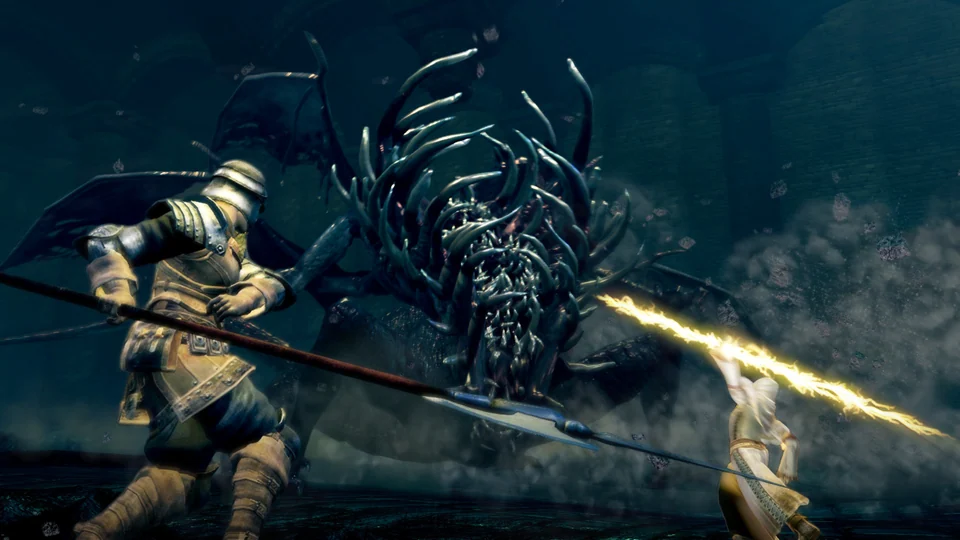
Tragic Beasts: Lore-Rich Horrors & Sympathetic Monsters
Table of Contents
- 01 Beyond the Disposable Adversary
- 02 Great Grey Wolf Sif: An Eternal Oath of Loyalty
- 03 Lisa Trevor: Resident Evil and the Horror of Prolonged Cruelty
- 04 Ludwig the Accursed: The Fall of the First Hunter
- 05 The Orphan of Kos: Born into Cosmic Grief
- 06 Ceaseless Discharge and the Witch of Izalith: Familial Mourning in Lava
- 07 The Sorrow and The Boss: Philosophical Ghosts in Metal Gear Solid
- 08 Maiden Astraea and Garl Vinland: The Saint of the Defiled
- 09 The Colossi: Ancient Monuments of Sacrificial Duty
- 010 The Catharsis of the Tragic Encounter
Beyond the Disposable Adversary
In arcade and early console gaming, monsters existed primarily as mechanical hit point sponges: grotesque obstacles designed to test player reflexes, drain ammunition reserves, and provide visceral visual payoff upon death. Their motivations were straightforward and unexamined: they were evil beings occupying dungeons, waiting to be slain by the heroic protagonist.
However, as narrative design matured, visionary writers and creature designers began to question this simplistic dichotomy. Drawing inspiration from Mary Shelley's Frankenstein, H.P. Lovecraft's cosmic dread, and ancient Greek tragic myth, game developers began constructing monsters whose monstrous appearance concealed heartbreaking histories of betrayal, biological experimentation, psychological trauma, and ancient sacrificial duty.
When a player discovers that the terrifying beast they are tasked with slaughtering is actually the tragic victim of an corrupt civilization, the act of combat transforms from triumphant power fantasy into a solemn, morally ambiguous tragedy.
Great Grey Wolf Sif: An Eternal Oath of Loyalty
FromSoftware's Dark Souls (2011), directed by Hidetaka Miyazaki, features one of the most emotionally devastating boss encounters in action RPG history: Great Grey Wolf Sif.
The tragic lore and mechanics of Sif:
- The Guardian of the Grave: When the player enters the moonlit forest grove in Darkroot Garden, Sif descends from an enormous gravestone, wielding the colossal greatsword of his fallen master, Knight Artorias, between his jaws. Sif does not fight out of malice; he guards Artorias's grave to prevent another mortal from claiming the Ring of the Abysswalker and succumbing to the corrupting darkness that destroyed his master.
- The Limping Animation: When Sif's health bar drops below ten percent, his aggressive combat choreography suddenly breaks. The proud wolf begins to limp painfully across the flowers, whimpering as he struggles to lift the heavy sword, making the player feel physically repulsive for delivering the final blow.
- The DLC Cinematic Shift: If the player completes the Artorias of the Abyss expansion first, rescuing a young Sif from the Chasm of the Abyss, the subsequent main-game boss cutscene changes. Sif recognizes the player's scent, hesitates, rubs his muzzle against the player's chest in tender recognition, and then sorrowfully draws the blade, bound by honor to fight to the death.
Lisa Trevor: Resident Evil and the Horror of Prolonged Cruelty
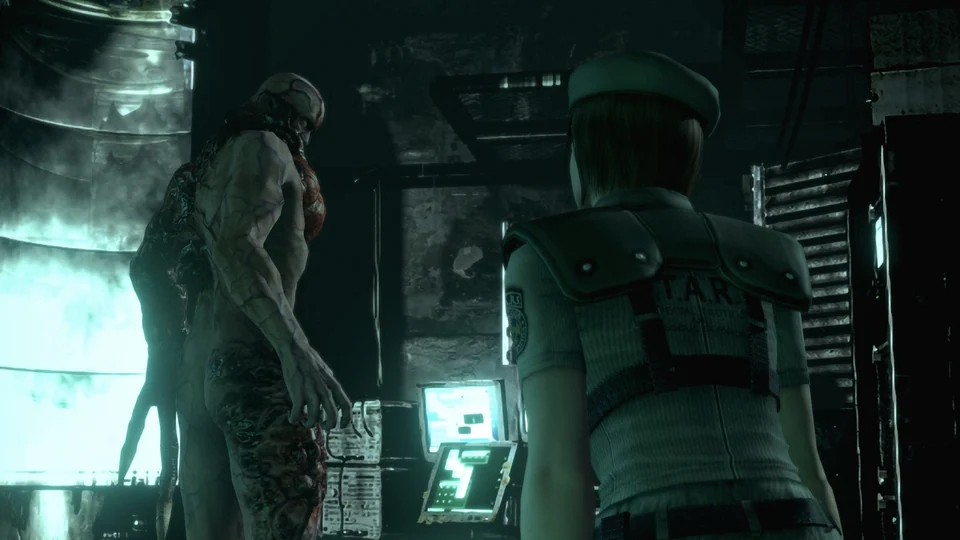
Capcom's 2002 GameCube remake of Resident Evil introduced Lisa Trevor, designed by Shinji Mikami, transforming the biological horror series from B-movie camp into genuine psychological tragedy.
The horrific history of Lisa Trevor:
- Decades of Laboratory Cruelty: As the daughter of Spencer Mansion architect George Trevor, Lisa was kidnapped alongside her mother by the Umbrella Corporation in 1967. For over thirty years, Umbrella scientists injected Lisa with experimental viral strains: Progenitor, T-Virus, and the NE-Alpha Parasite.
- The Patchwork Flesh Mask: Despite suffering unimaginable physical mutation, Lisa's childlike psyche clung desperately to the memory of her mother. Unable to comprehend her mother's death, Lisa tore the faces off laboratory attendants and stitched them into a grotesque mask over her own deformed skull, believing she could return her mother's face to her.
- Invulnerable Melancholy: In the game, Lisa is functionally immortal, dragging heavy iron chains behind her through the gloomy subterranean forest. Her horrific, distorted wails of 'Mother' echoing through the damp cabin evoke deep horror combined with profound pity.
Ludwig the Accursed: The Fall of the First Hunter
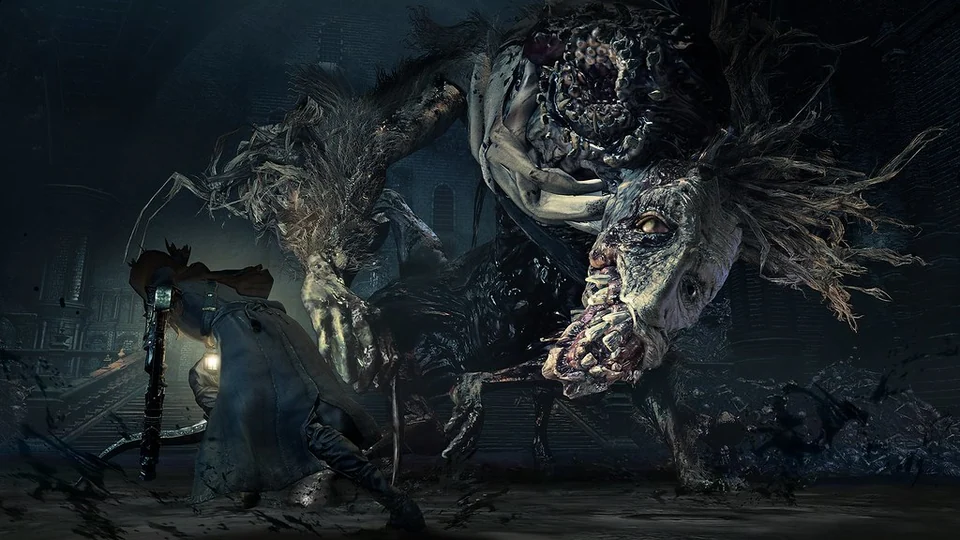
In Bloodborne: The Old Hunters (2015), FromSoftware presented Ludwig, the legendary founder of the Healing Church's workshop who led Yharnam's first crusades against the beast plague.
Narrative and visual anatomy of Ludwig:
- Body Horror Embodiment: Ludwig has mutated into an incomprehensible monstrosity: an equine-humanoid abomination with multiple sightless eyes inside a gaping mouth, twisted bone limbs, and a pulsating secondary jaw of teeth embedded in his flank. His first phase is characterized by frantic, feral shrieking and animal savagery.
- The Moonlight Awakening: At half health, Ludwig catches sight of his beloved Holy Moonlight Sword buried beneath a pile of corpses. As the blade glows with cosmic cerulean light, Ludwig's human consciousness suddenly awakens amidst the monstrous flesh.
- The Reclaiming of Honor: Phase two shifts from frantic beast combat to an operatic, dignified duel accompanied by a breathtaking symphonic waltz. Ludwig fights not as a feral animal, but as a noble knight reclaiming his humanity in his final moments of life.
The Orphan of Kos: Born into Cosmic Grief
Also from Bloodborne, the Orphan of Kos serves as the horrific culmination of the Healing Church's cardinal sin at the Fishing Hamlet.
Themes of the Orphan:
- Birth from a Dead Deity: The Orphan crawls weeping from the womb of the beached corpse of Great One Kos, staring up at the pale sky and crying like a newborn human infant while wielding a placenta weapon.
- Retribution for Scholar Violations: The hunters of Byrgenwerth desecrated the Fishing Hamlet, drilling into the skulls of villagers to search for eyes. The Orphan represents the distilled, agonizing nightmare of violated divinity, crying in sorrowful rage as it battles the player beneath the eclipsed moon.
Ceaseless Discharge and the Witch of Izalith: Familial Mourning in Lava
In Dark Souls, the Demon Ruins are guarded by Ceaseless Discharge, the youngest and only son of the Witch of Izalith. Born with an agonizing condition where lava constantly seeped from his skin, his sisters gave him the Orange Charred Ring to soothe his sores. When he dropped the ring, the sores erupted into a gargantuan monstrosity of flame and magma.
The tragic revelation:
- Eternal Vigil Over Sister's Corpse: Ceaseless Discharge does not attack the player upon entering his domain. He stands completely passive, gazing sorrowfully at an altar holding the garments of his deceased sister, Quelana. Only when the player commits grave robbery by stealing the Gold-Hemmed Black Robes does he roar in furious familial grief and attack.
- Physical Deformity and Pain: His combat movements are clumsy and pained, violently slamming molten tentacles onto stone walkways, evoking pity for a cursed son guarding his family's final resting place.
The Sorrow and The Boss: Philosophical Ghosts in Metal Gear Solid
Hideo Kojima's Metal Gear Solid 3: Snake Eater (2004) subverted boss conventions through The Sorrow, a deceased medium who forces Naked Snake to walk down an endless, purgatorial river.
The river of consequences:
- Walking Through Player Guilt: In The Sorrow's river, every single enemy soldier Snake killed throughout the mission appears as a bloody phantom, their slashed throats or gunshot wounds bleeding into the misty water while they whisper eerie accusations. If the player completed the game non-lethally, the river is almost completely empty, transforming a boss battle into a direct moral audit of player aggression.
- The Boss's Tragic Patriotism: Slaying Snake's mentor, The Boss, amidst a sea of white Star of Bethlehem flowers stands as one of gaming's greatest anti-war tragedies. Her death was not a defeat of villainy, but a state-sanctioned execution demanded by political convenience.
Maiden Astraea and Garl Vinland: The Saint of the Defiled
FromSoftware's Demon's Souls (2009) delivered the ultimate moral inversion through Maiden Astraea in the Valley of Defilement. Astraea, a revered church saint, traveled to the diseased swamp where Boletaria abandoned its sick, crippled, and unwanted outcasts. Horrified by the callousness of a god who permitted such agony, Astraea accepted the power of a Demon's Soul to grant solace and ease the suffering of the wretched inhabitants.
The tragedy of the encounter:
- Non-Combative Divinity: Astraea sits peacefully in a pool of diseased sludge, refusing to raise a weapon against the player. Her devoted bodyguard, Garl Vinland, stands unyielding in narrow armor, fighting only to defend her sanctuary from mercenary soul hunters.
- The Death of the Protector: If the player kills Garl Vinland, Astraea refuses to retaliate, speaking softly to the player: Take your precious Demon's Soul... you have killed my protector, and I have no reason to live. She voluntarily ends her own life, leaving the player clutching a glowing soul in the silent darkness, confronting the horrifying realization that their quest was driven by unthinking greed rather than righteousness.
The Colossi: Ancient Monuments of Sacrificial Duty
In Fumito Ueda's Shadow of the Colossus, the sixteen colossi represent architectural and ecological wonders rather than hostile predators.
Why slaying the colossi evokes profound guilt:
- Natural Docility: Many colossi—such as Phalanx, the colossal desert flying serpent, or Hydrus, the deep-lake electric leviathan—exhibit zero hostility toward Wander until he physically pierces their skin with glowing magical runes. They exist as living, breathing tectonic formations inhabiting serene ancient sanctuaries.
- The Somber Music of Victory: When a colossus finally collapses to the ground, there is no celebratory fanfare. The music abruptly transitions to Kow Otani's mournful, funeral requiem The End of the Battle. Black shadowy tendrils erupt from the beast's corpse, piercing Wander's chest and leaving his avatar looking progressively gaunt, pale, and spiritually corrupted.
The Catharsis of the Tragic Encounter
Tragic monsters remind players that cruelty and monstrosity are rarely innate conditions; they are the consequences of systemic violence, hubristic science, and ancient trauma. When a game forces us to mourn the creature we were commanded to destroy, it breaks the artificial boundaries of interactive entertainment and touches the universal human experience of grief, empathy, and reverence for living things.