Game Companions: Artificial Empathy & Dynamic AI
Table of Contents
- 01 The Engineering of Artificial Empathy
- 02 Yorda in Ico: The Poetics of Holding Hands
- 03 Agro in Shadow of the Colossus: Autonomous Equine Loyalty
- 04 Trico in The Last Guardian: Simulating Animal Stubbornness
- 05 Elizabeth in BioShock Infinite: Narrative Presence and Systemic Grace
- 06 Dogmeat and Ellie: Companionship in the Ruins of Civilization
- 07 BD-1: Kinetic Micro-Companion Design in Star Wars Jedi
- 08 BT-7274: Protocol 3 and the Soul of a Machine
- 09 The Evolutionary Horizon of Artificial Companionship
The Engineering of Artificial Empathy

Designing a video game companion is one of the most perilous challenges in software engineering. If an artificial intelligence companion pathfinds poorly, blocks narrow doorways, attacks enemies prematurely, or repeats bark lines incessantly, the player experiences intense irritation, viewing the companion as an escort-mission liability. Conversely, if a companion is completely invincible and eliminates all adversaries autonomously, the player's agency is compromised.
The greatest companions in gaming history transcend these computational pitfalls by integrating mechanical utility with emotional resonance. They are engineered not as subordinate tools, but as autonomous emotional agents with their own goals, vulnerabilities, and developmental arcs.
Technical foundations of modern companion design:
- Goal-Oriented Action Planning (GOAP): Companions continuously evaluate environmental affordances, dynamically selecting behaviors based on player positioning, combat intensity, and narrative pacing.
- Non-Verbal Animation State Machines: Emotional connection is forged primarily through micro-animations: subtle glances toward points of interest, shivers in freezing climates, protective crouching during artillery barrages, and posture relaxation during rest sequences.
- Asymmetric Mechanical Interdependence: The player protects the companion from physical harm, while the companion provides essential navigational, linguistic, or environmental abilities the player lacks.
Yorda in Ico: The Poetics of Holding Hands
Fumito Ueda's Ico (2001) established the emotional grammar of video game companionship through a single, revolutionary mechanical verb: holding hands.
Design innovations in Ico:
- The Haptic Connection: Holding down the R1 shoulder button physically links the horned boy Ico to the ethereal princess Yorda. The dual-shock controller transmits subtle vibrations, simulating the physical sensation of leading another human being by the hand across crumbling castle battlements.
- Yorda's Fragile Autonomy: Yorda cannot run fast, jump across wide gaps, or fight shadow creatures. However, she possesses the unique magical power to unlock ancient sealed idols that bar Ico's progress. She does not blindly follow; she pauses to inspect fluttering birds, sits peacefully on stone benches, and expresses genuine fear when shadows emerge.
- Reversing the Escort Mission: While escort missions are notoriously despised in gaming, Ico turns the entire game into an act of tender physical stewardship, making the act of letting go feel genuinely terrifying.
Agro in Shadow of the Colossus: Autonomous Equine Loyalty

Also conceived by Fumito Ueda, Agro the black mare in Shadow of the Colossus represents one of the most realistic animals ever programmed in interactive media.
The computational and emotional design of Agro:
- Non-Vehicular Controls: Ueda specifically refused to program Agro like an automobile. The player does not steer the horse directly; the player uses reins to urge Agro forward, while the horse's internal AI navigates path obstacles, avoids stepping off sheer cliff edges, and follows natural dirt trails autonomously.
- Combat Platforming Synergy: Galloping alongside colossal beasts across wind-swept plains requires perfect timing to leap from Agro's saddle directly onto furry colossus limbs. Agro circles the battlefield, whistling when called and never panicking despite earth-shaking footsteps.
- The Bridge Sacrifice: When Agro throws Wander across a crumbling stone chasm seconds before plunging into a ravine, the emotional devastation felt by players worldwide solidified the bond between human and digital steed.
Trico in The Last Guardian: Simulating Animal Stubbornness
Released in 2016 following nearly a decade of development, Ueda's The Last Guardian introduced Trico, a gigantic chimeric hybrid of bird, cat, and dog that stands as one of the most complex artificial life simulations ever coded.
Computational and psychological complexity of Trico:
- Procedural Behavioral AI: Unlike typical companion bots that execute commands instantaneously, Trico is programmed with intentional animal stubbornness, fear, and distraction. When the player calls Trico, the creature must perceive the call, calculate acoustic line-of-sight, evaluate its own current emotional state, and decide whether to obey or investigate a nearby pool of water.
- Dynamic Feather and Muscle Physics: Pushing the PS4 hardware, thousands of individual feathers react to ambient wind forces, fear responses (ruffling when agitated), and physical contact from the boy climbing through its plumage.
- Emotional Reciprocity: Over dozens of hours, what initially begins as an erratic, terrifying beast gradually matures into a fiercely protective guardian that will endure catastrophic injuries to save the player from harm.
Elizabeth in BioShock Infinite: Narrative Presence and Systemic Grace
Ken Levine and Irrational Games faced immense skepticism when introducing Elizabeth in BioShock Infinite (2013), given the historical frustrations associated with companion characters in first-person shooters.
Key engineering solutions for Elizabeth:
- Elimination of Baby-Sitting Mechanics: Elizabeth has no health meter, cannot be killed in combat, and never demands immediate player intervention during gunfights. Instead, she supports the player by scrounging for ammunition, tossing medical kits during critical moments, and using spatial rifts to summon environmental cover.
- Environmental Curiosity AI: When the player explores Columbia between combat encounters, Elizabeth does not trail behind like an obedient pet. She walks ahead to examine storefront displays, leans against railings to gaze at floating monuments, sits on park benches, and dances with local street musicians.
- Complex Thematic Growth: Elizabeth transitions from an innocent sheltered captive marveling at the world to a traumatized, vengeful force of nature, carrying the philosophical weight of the narrative.
Dogmeat and Ellie: Companionship in the Ruins of Civilization
Companions in post-apocalyptic landscapes serve as vital anchors of human warmth against overwhelming cruelty:
Bethesda Game Studios' iconic canine companion provides unconditional loyalty in a cynical nuclear wasteland. In Fallout 4, Dogmeat sniffs out concealed military ammunition caches, pins hostile raider limbs in close-quarters combat, and retrieves heavy weapons from locked storage lockers without triggering automated security turrets. Returning to a dusty settlement to find Dogmeat curled up on a dog bed offers authentic emotional solace.
- Dogmeat in Fallout:
Naughty Dog engineered Ellie to function as both a combat partner and emotional mirror for Joel. Rather than relying on simple follow scripts, Ellie scouts ahead, ducks behind low walls when hunters scan with flashlights, whispers positional alerts, and hurls bricks to stagger charging runners, turning cooperative combat into an organic dance of desperate survival.
- Ellie in The Last of Us Part I:
BD-1: Kinetic Micro-Companion Design in Star Wars Jedi
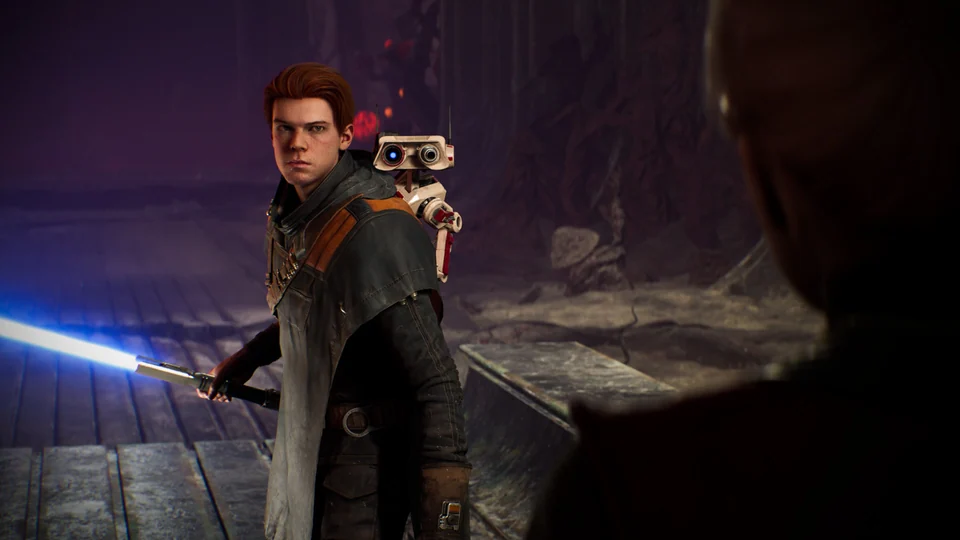
Respawn Entertainment's Star Wars Jedi: Fallen Order and Survivor engineered BD-1, a bipedal exploration droid that perches directly on Cal Kestis's shoulder.
Key micro-companion design triumphs:
- Tactile Shoulder Perching: BD-1 physicalizes the emotional connection by leaning into Cal's neck during intense platforming, projecting holographic maps from his ocular sensor, and diving into ancient technological consoles to slice electronic locks.
- Emotional Chirps and Musical Audio Design: Sound designers Ben Minto and Nick von Kaenel used synthesized melodic trills that communicate clear emotional intent without human dialogue, making BD-1 feel like an affectionate mechanical terrier that enhances every moment of exploration.
BT-7274: Protocol 3 and the Soul of a Machine
Respawn Entertainment's Titanfall 2 (2016) surprised the industry by delivering one of the most beloved buddy-cop narratives in modern sci-fi through BT-7274, an autonomous Vanguard-class Titan combat chassis.
Elements driving BT's unexpected emotional appeal:
- Dynamic Dialogue Wheel Options: Players can respond to BT's dry, analytical assessments using humorous or serious conversational prompts during missions, fostering an authentic camaraderie between pilot and machine.
- Mechanical Symbiosis: The player experiences high-speed parkour mobility on foot, contrasted with the titanic defensive firepower of piloting BT directly. Exiting BT to unlock doors while watching the mech autonomously engage enemy platoons creates mutual tactical respect.
- Protocol 3: Protect the Pilot: BT's programming is governed by three protocols. When the mechanical directive to protect the human pilot transforms into an apparent act of self-sacrifice, players experience genuine emotional devastation.
The Evolutionary Horizon of Artificial Companionship
From Yorda's gentle touch and Agro's gallop to BT-7274's mechanical loyalty and Ellie's protective vigilance, the evolution of video game companions mirrors humanity's ongoing dialogue with technology and empathy. When an artificial intelligence in a game exhibits vulnerability, loyalty, and agency, it ceases to be an arrangement of conditional logic trees and becomes a true digital companion.
These digital relationships remain etched in our memories because they remind us that the greatest adventures are never walked alone, forging bonds of simulated loyalty that feel astonishingly real.