
Top 5 Sega Genesis Games: Five 16-Bit Classics
Table of Contents
- 01 The 16-Bit Architecture: Motorola 68000 and Yamaha FM Synthesis
- 02 1. Sonic the Hedgehog (1991)
- 03 2. Streets of Rage 2 (1992)
- 04 3. Golden Axe (1989)
- 05 4. Gunstar Heroes (1993)
- 06 5. Phantasy Star IV: The End of the Millennium (1993)
- 07 Silicon Longevity, Battery Backups, and 16-Bit Emulation Fidelity
The 16-Bit Architecture: Motorola 68000 and Yamaha FM Synthesis
Launched across Western markets in 1989, the Sega Genesis—known as the Mega Drive throughout Europe and Japan—fundamentally transformed consumer expectations for home video gaming. Under the engineering direction of Masami Ishikawa, Sega designed console architecture derived directly from its commercially triumphant System 16 arcade hardware. At the core of the system sat a 16/32-bit Motorola 68000 central processor running at 7.67 megahertz, supported by a secondary 8-bit Zilog Z80 coprocessor dedicated to managing input/output operations and driving sound synthesis.
This dual-processor architecture was complemented by a custom Video Display Processor capable of rendering dual scrolling background planes, hardware window overlays, and up to eighty simultaneous on-screen sprites. Sonically, the Genesis carved out a distinctive, aggressive acoustic signature through the Yamaha YM2612 six-channel Frequency Modulation sound synthesizer paired with a Texas Instruments programmable sound generator.
Sega's aggressive engineering philosophy culminated in famous marketing terminology like "Blast Processing"—a consumer-facing term rooted in the genuine hardware capability of DMA transfers to rapidly refresh color palettes and tile data during horizontal blanking intervals. The five seminal titles examined below demonstrate how master developers pushed the Genesis hardware beyond its documented specifications, delivering arcade-quality action, peerless audio composition, and sprawling cinematic adventures.
1. Sonic the Hedgehog (1991)

- Primary Objective: Accelerate through six dynamic zones across South Island, liberate captive forest wildlife, neutralize Dr. Ivo Robotnik's mechanized creations, and secure the six mystical Chaos Emeralds.
- Core Protagonists & Adversaries: Sonic the Hedgehog, trapped organic animals, and the industrial megalomaniac Dr. Ivo Robotnik (later known as Dr. Eggman).
- Mechanical Architecture & Spatial Design: Naka's revolutionary physics engine calculates player momentum across 360-degree curved terrain. Running down steep declines dramatically increases Sonic's velocity, allowing him to scale vertical wall ascents, sprint through full loop-de-loops, and leap across expansive chasms.
Green Hill Zone stands as an eternal monument of readable, organic spatial design. Its rolling checkered topography features multiple vertical pathways: skilled players who maintain forward momentum remain on the upper canopy routes where hazards are sparse and rewards abundant, while stumbling players drop into lower subterranean routes filled with spikes and robotic adversaries.
2. Streets of Rage 2 (1992)
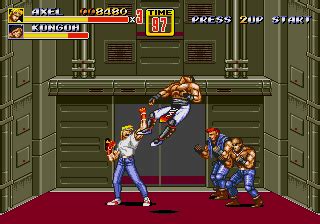
Directed by Noriyoshi Ohba and developed collaboratively between Sega, Ancient, and MNM Software, Streets of Rage 2 represents the pinnacle of the side-scrolling beat 'em up genre on 16-bit hardware. Expanding vastly upon the foundation of its predecessor, the sequel re-engineered hit collision boxes, expanded character combat palettes, and introduced an internationally revered electronic music soundtrack that pushed the Yamaha YM2612 chip into uncharted acoustic territory.
- Primary Objective: Battle through eight heavily guarded urban districts, dismantle a resurgent criminal syndicate, rescue captured comrade Adam Hunter, and defeat crime lord Mr. X.
- Core Protagonists & Adversaries: Returning martial artists Axel Stone and Blaze Fielding, joined by heavyweight wrestler Max Thunder and roller-blading acrobat Eddie "Skate" Hunter, combating Syndicate enforcers, kickboxers, and ninja assassins.
- Mechanical Architecture & Spatial Design: Streets of Rage 2 departed from generic button-mashing by introducing street-fighter style directional special moves. Axel's devastating Dragon Smash and Grand Upper offered invincible startup frames at the cost of slight health reduction, requiring players to balance crowd control offense against tactical self-preservation.
The acoustic design of Streets of Rage 2 remains legendary in video game history. Legendary composer Yuzo Koshiro alongside Motohiro Kawashima authored a custom sound driver in assembly to force the Yamaha YM2612 and DAC to produce cutting-edge Chicago house, Detroit techno, and European hardcore breakbeats.
3. Golden Axe (1989)
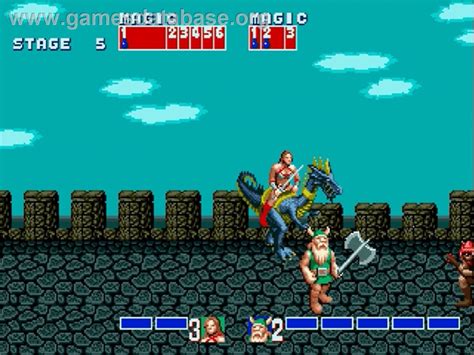
Designed by Makoto Uchida—who simultaneously spearheaded the creation of Altered Beast—Golden Axe brought high-fantasy sword-and-sorcery arcade action straight into the living room. Ported from Sega's System 16 arcade hardware to the Genesis with remarkable fidelity, the console conversion included two entirely new narrative stages, expanded magic mechanics, and a duel battle mode that solidified the title as an essential cooperative multiplayer staple.
- Primary Objective: Traverse the devastated realm of Yuria, rescue the captive King and Princess, reclaim the mythical Golden Axe artifact, and execute the despotic tyrant Death Adder.
- Core Protagonists & Adversaries: Ax Battler the barbarian warrior, Tyris Flare the Amazon wielding fire sorcery, and Gilius Thunderhead the dwarven berserker armed with a massive battleaxe.
- Mechanical Architecture & Spatial Design: Combat is deliberately weighted and tactical. Players execute lunging dash attacks, overhead hilt strikes, grappling throws, and mount rideable bipedal beasts (such as fire-breathing Dragons and tail-whipping Bizarrians) to dominate the battlefield.
A central mechanical breakthrough of Golden Axe was its elemental magic system. Throughout their trek, players ambush mischievous blue thieves to hoard magic potions. When unleashed, the screen freezes as full-screen elemental spectacles erupt: Tyris Flare's golden dragon incinerates entire waves of skeleton warriors with roaring flames.
4. Gunstar Heroes (1993)
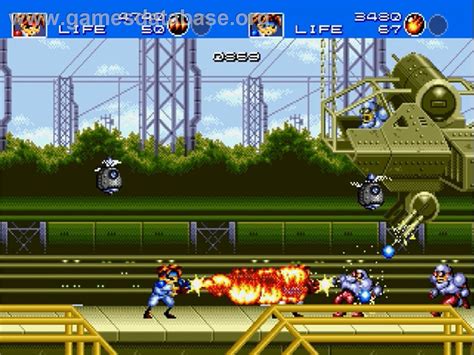
Developed by Treasure—a newly formed independent studio founded by former Konami developers led by Masato Maegawa—Gunstar Heroes burst onto the Genesis as an audacious technical marvel. Refusing to accept the purported hardware limitations of the console, Treasure programmed custom assembly routines that achieved astonishing visual spectacles: massive multi-jointed boss sprites, real-time scaling and rotation effects, and explosive projectile frenzies with virtually zero frame rate slowdown.
- Primary Objective: Journey across the planet Gunstar 9, thwart the militarized Empire led by Colonel Red, rescue brainwashed brother Green, and prevent the resurrection of the planetary destroyer Golden Silver.
- Core Protagonists & Adversaries: Gunstar Red and Gunstar Blue, supported by technical genius Yellow, battling mechanized imperial battalions, Seven Force's seven transforming combat forms, and Colonel Red.
- Mechanical Architecture & Spatial Design: Gunstar Heroes revolutionized run-and-gun combat by introducing an ingenious four-weapon combining matrix: Force, Lightning, Chaser, and Fire. Players could equip two weapons simultaneously, combining their properties into sixteen unique hybrid firing modes, such as homing lasers, explosive flamethrowers, and piercing energy streams.
5. Phantasy Star IV: The End of the Millennium (1993)
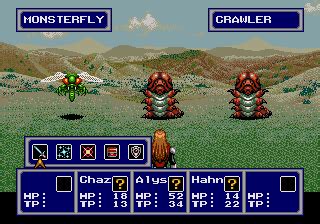
Directed by Rieko Kodama and Toru Yoshida with scenarios scripted by Akinori Nishiyama, Phantasy Star IV stands as the crowning jewel of 16-bit role-playing games on the Sega Genesis. Serving as the grand narrative culmination of the Algol solar system saga, Phantasy Star IV combined grand science-fantasy worldbuilding, rapid turn-based tactical combat, and breathtaking manga-style visual panel storytelling.
- Primary Objective: Investigate catastrophic ecological failures across the desert world of Motavia, unravel the cosmic corruption spreading through planetary climate control biomes, and confront the primordial malice of the Dark Force.
- Core Protagonists & Adversaries: Hunter Chaz Ashley and his veteran mentor Alys Brangwin, joined by android Demi, wizard Rune Walsh, and Palman allies against biomechanical mutants and the cosmic entity The Profound Darkness.
- Mechanical Architecture & Spatial Design: Combat in Phantasy Star IV eliminated the tedious menu navigation of traditional JRPGs by implementing Macro systems. Players pre-programmed tactical routines that triggered devastating Macro Combinations—such as combining Chaz's Cross Cut with Alys's Foi technique to unleash the incandescent Fire Storm burst.
Narratively and visually, the game departed from static text boxes by framing crucial dramatic beats within lavishly illustrated, full-screen manga panels. Key story events—such as tragic mentor sacrifices and interstellar voyages—conveyed immense emotional resonance through dynamic visual composition and expressive character art.
Silicon Longevity, Battery Backups, and 16-Bit Emulation Fidelity
Preserving the heritage of the Sega Genesis and Mega Drive library involves confronting complex technological hurdles unique to 16-bit hardware architecture. While the robust Motorola 68000 and discrete Z80 CPUs generally resist hardware degradation, aging physical cartridges present acute maintenance vulnerabilities:
- SRAM Battery Exhaustion: Epic titles like Phantasy Star IV relied on CR2032 lithium coin batteries soldered to internal PCBs to retain save data in volatile Static RAM. Four decades post-manufacture, original batteries have depleted, requiring careful precision de-soldering and battery holder retrofits to preserve historical campaign files.
- FM Synthesis Emulation Complexity: Accurately emulating the Yamaha YM2612 FM chip remains one of the most demanding tasks in retro computing. Subtleties like the chip's internal DAC ladder effect and crossover distortion require cycle-accurate modeling to reproduce authentic musical harmonics without high-frequency harshness.
- VDP Video Timing and Raster Interrupts: Sophisticated titles like Gunstar Heroes relied on tight horizontal raster interrupt timings to manipulate mid-frame scrolling registers and palette swaps.
By capturing pristine bit-exact ROM dumps, documenting ASIC register behaviors, and cataloging physical board variations, video game archivists ensure that the kinetic energy, sonic brilliance, and boundary-pushing hardware artistry of the 16-bit generation remain immortalized and accessible for interactive scholars worldwide.