Virtual Ruins: Eerie Beauty & Abandoned Game Places
Table of Contents
- 01 The Ludology of Ruin and Digital Decay
- 02 S.T.A.L.K.E.R. and Pripyat: Industrial Rust and Radioactive Absence
- 03 Shadow of the Colossus: Sacred Emptiness and the Forbidden Land
- 04 Rapture in BioShock: Art Deco Drowning in Ideological Hubris
- 05 NieR: Automata: Green Post-Humanism in the City Ruins
- 06 The Mechanics of Environmental Storytelling
The Ludology of Ruin and Digital Decay
In interactive spatial design, a ruin is never merely a backdrop. It is an active storytelling engine. While cinema presents ruins through passive framing, video games require the player to physically navigate, climb, and inhabit decay. The emotional resonance of virtual ruins stems from a fundamental tension: the contrast between the permanence of digital code and the simulated fragility of the world that code portrays. A stone archway in an ancient citadel does not decay organically through weathering; every fracture, moss overlay, and fallen column represents a conscious asset placement decision by an environmental designer.
Architectural theorists identify ruins as spaces where human intention has been interrupted by time. In video games, this interruption creates negative space for narrative interpretation. When a player wanders through the silent boulevards of a sunken metropolis or the crumbling buttresses of a desert sanctuary, the environment communicates past events without dialogue or exposition. Broken banquet tables, derailed transit trams, and collapsed fortifications convey social hierarchy, catastrophic disruption, and the passage of centuries through pure geometry and material shaders.
Virtual ruins also solve a fundamental ludological requirement: spatial gating. A pristine modern city requires convincing civilian populations, working infrastructure, and legal boundaries. A ruined city naturally justifies blocked paths, missing bridges, vertical climbs, and dangerous hazards without breaking player suspension of disbelief. The ruin transforms architectural catastrophe into an intuitive navigational puzzle that guides the player's spatial journey.
S.T.A.L.K.E.R. and Pripyat: Industrial Rust and Radioactive Absence
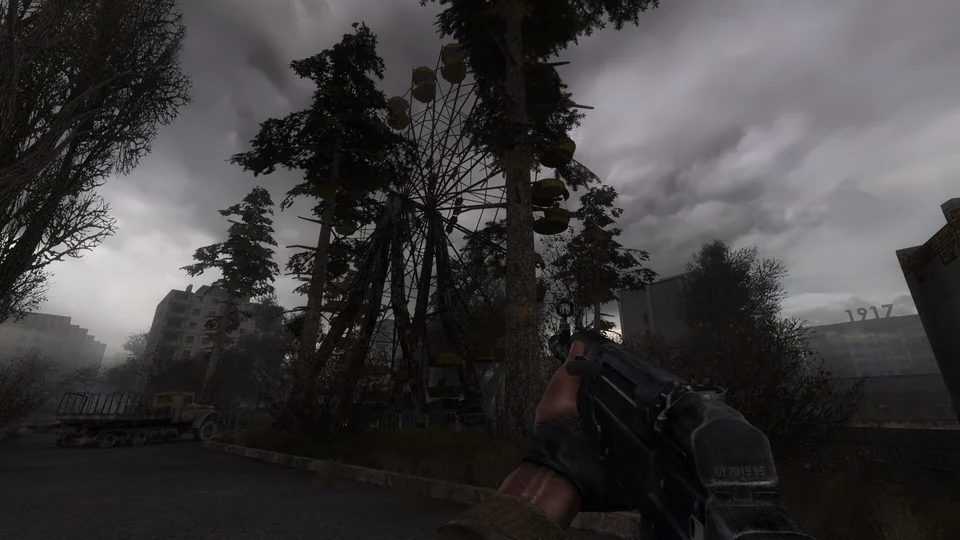
GSC Game World's S.T.A.L.K.E.R.: Shadow of Chernobyl (2007) and its successor Call of Pripyat established benchmark standards for atmospheric realism in abandoned environments. Set within an alternate-reality Chernobyl Exclusion Zone, the developers conducted photographic and laser-scanning expeditions into the real-world ruins of Pripyat to capture the texture of Soviet modernist decay.
Key design elements that define the Zone's spatial melancholy:
- Authentic Material Texturing: Rather than relying on generic concrete noise textures, the engine utilized high-resolution photographic source materials capturing spalling concrete, oxidized steel rebar, peeling lead-based enamel paint, and damp birch forest rot.
- The A-Life System: The game's artificial intelligence engine allowed mutants, military patrols, and rival stalkers to navigate the vast ruined landscapes autonomously, regardless of player proximity. Exploring an abandoned kindergartener building or an empty cooling tower felt profoundly dangerous because the ruins remained dynamic habitats for predatory ecosystems.
- Soundscape Engineering: Acoustic design favored harsh wind whistling through rusted ventilation shafts, distant Geiger counter crackles, and creaking metal girders over orchestral scoring, emphasizing the player's profound isolation amidst technological ruins.
The ruins of Pripyat in S.T.A.L.K.E.R. resonate because they mirror a real-world technological tragedy. The Ferris wheel in Pripyat's amusement park, which was scheduled to open days after the real reactor catastrophe in April 1986, stands in the digital engine as a frozen monument to interrupted civilian life, surrounded by radioactive anomalies and wandering phantoms.
Shadow of the Colossus: Sacred Emptiness and the Forbidden Land
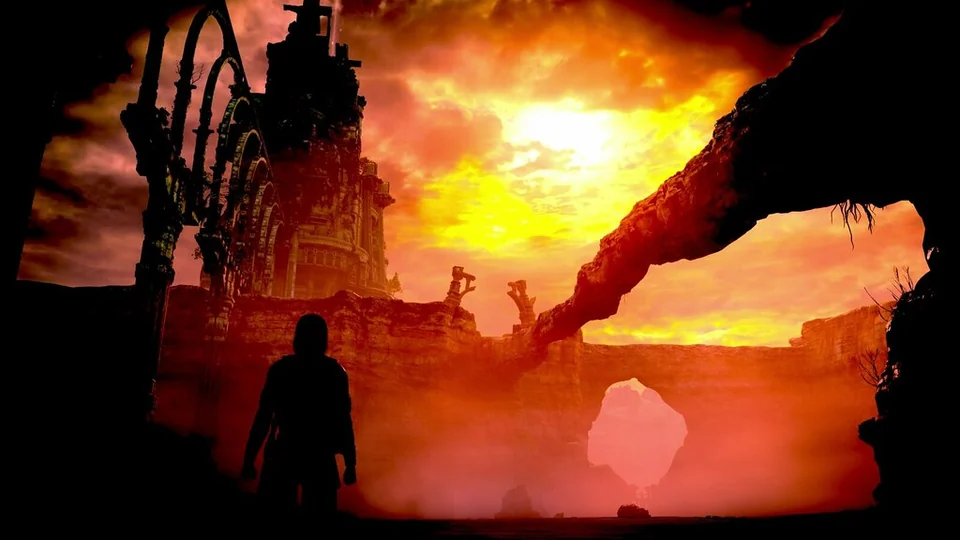
Fumito Ueda's Shadow of the Colossus (2005) presents an entirely different aesthetic philosophy: the romantic sublimity of an ancient, uninhabited continent. The Forbidden Land contains no towns, no merchant caravans, no friendly non-player characters, and no hostile roaming wildlife beyond sixteen towering colossi.
Spatial strategies utilized in Team ICO's masterwork:
- Extreme Structural Scale: Colossal aqueducts span chasms that take minutes of real-time riding to cross, yet lead to dried riverbeds and sealed temple gateways. The sheer disproportion between the small protagonist Wander and the monumental cyclopean architecture emphasizes human insignificance.
- Architectural Syncretism: The ruins do not reflect a single historic human civilization. Ueda's team combined elements of ancient Roman aqueducts, Pre-Columbian Mesoamerican pyramids, Mesopotamian ziggurats, and brutalist concrete forms. This geographic ambiguity prevents the player from anchoring the setting to real-world history, elevating the ruins to mythic abstraction.
- Atmospheric Bloom and Volumetric Haze: Pushing the PlayStation 2 emotion engine to its limits, the rendering pipeline applied heavy light-bleed shaders and distance fog. The ruins seem partially dissolved by sunlight and dust, suggesting an era so ancient that physical reality itself has begun to fade.
The temple at the center of the Forbidden Land acts as an architectural axis mundi, anchoring the player's spatial orientation across a desolate, mournful paradise where every crumbling stone silently questions the moral validity of the protagonist's quest.
Rapture in BioShock: Art Deco Drowning in Ideological Hubris
Irrational Games' BioShock (2007) introduced Rapture, an underwater metropolis built on the floor of the North Atlantic Ocean. Designed by objectivist industrialist Andrew Ryan as a laissez-faire utopia free from government regulation, the city collapsed into catastrophic civil war and genetic psychosis.
Architectural and environmental decay in Rapture:
- Juxtaposition of Luxury and Ruin: Grand Art Deco ballrooms, gilded brass statues, and velvet lounge carpets are drowned beneath leaking ocean water, cracked reinforced glass, and biological residue. This visual dissonance reinforces the thematic critique of uncontrolled corporate arrogance.
- Dynamic Water and Structural Failure: Water in Rapture is not merely a graphical shader; it is an active structural antagonist. Corridors groan under tectonic water pressure, bulkheads buckle, and ceiling cascades short-circuit lighting grids, transforming once-glamorous department stores into claustrophobic aquatic graves.
- Tragic Environmental Dioramas: Environmental artists placed haunting spatial vignettes throughout the ruins: abandoned baby carriages containing revolvers, uncollected medical bills sitting next to decomposing corpses, and tragic audio diaries chronicling the slow descent into madness.
Rapture remains one of gaming's most celebrated environments because its architectural style directly mirrors its ideological downfall, turning every shattered glass corridor into an eloquent tombstone for Ryan's ruined dream.
NieR: Automata: Green Post-Humanism in the City Ruins
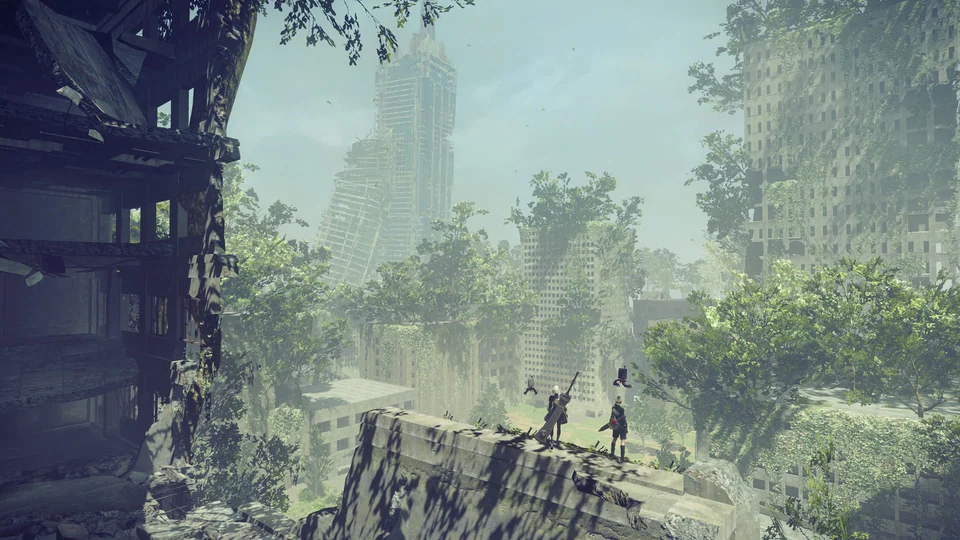
PlatinumGames and Yoko Taro's NieR: Automata (2017) presents an intriguing evolution of the ruin aesthetic: the post-human landscape where nature has peacefully reclaimed a fallen human metropolis. Unlike the radioactive horrors of S.T.A.L.K.E.R. or the claustrophobia of BioShock, NieR's City Ruins possess an ethereal, melancholic beauty.
Key environmental techniques in NieR: Automata:
- Verdant Reclamation and Canopy Growth: Enormous weeping willow branches and dense moss carpets drape over collapsed multistory highway bridges and corporate office towers. Sunlight filters through lush foliage, illuminating crystalline waterfalls that crash through empty subway stations.
- Non-Anthropocentric Ecosystems: With humanity extinct for millennia, wild boar and deer graze peacefully in the central pedestrian plazas alongside primitive machine lifeforms who wear top hats, tend flowerbeds, and mimic forgotten family rituals.
- Melancholy Acoustic Framing: Keiichi Okabe's acoustic guitar and vocal score shifts dynamically from gentle solo humming to sweeping choral grandeur as the player transitions from overgrown city streets to the hollow expanse of the ruined amusement park.
The City Ruins embody the concept of mono no aware—the gentle sadness regarding the impermanence of all things—showing that the end of human civilization is not necessarily an apocalyptic nightmare, but a return to natural equilibrium.
The Mechanics of Environmental Storytelling
Creating convincing virtual ruins requires environmental artists to implement specific design disciplines that prevent environments from feeling like artificial stage sets:
- Chronological Layering: A believable ruin displays multiple historical eras. In Dark Souls, an environmental artist models an ancient archdemon foundation, followed by a medieval Gwyn-era cathedral built on top of it, followed by recent barricades erected by desperate hollow soldiers. Each layer uses distinct architectural styles and materials.
- Functional Coherence: Even in ruins, spaces must suggest their original mechanical purpose. Archivists can identify where water flowed, where power was routed, where trash was discarded, and how humans moved through the complex. If a ruined structure has no identifiable entrance, kitchen, or ventilation, it breaks player immersion.
- Natural Reclamation Vectors: Nature reclaims architecture along predictable physical pathways. Roots exploit masonry mortar joints; rainwater collects in floor depressions, cultivating lichen colonies; ceiling collapses deposit soil that enables saplings to sprout indoors. Shaders must replicate these biological growth patterns accurately.
Virtual ruins allow players to experience the passage of deep time. In a world characterized by relentless digital acceleration and disposable content, wandering through the stone silence of an ancient virtual ruin offers a rare moment of contemplative digital stillness, inviting players to reflect on impermanence, resilience, and the fragile beauty of what remains.