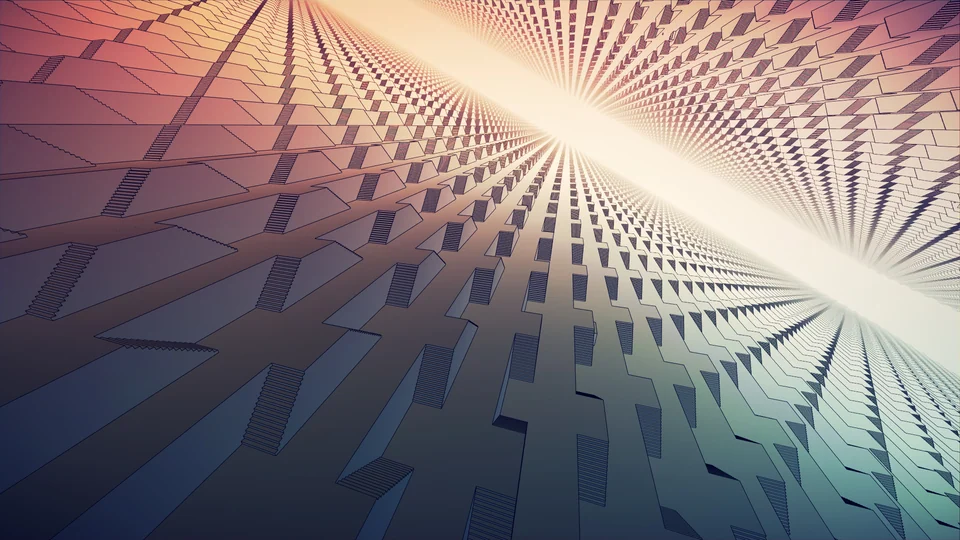
Surreal Architecture: Non-Euclidean Worlds & Geometry
Table of Contents
- 01 Liberating Architecture from Physical Gravity
- 02 Control and The Oldest House: Brutalism as a Living Organism
- 03 Portal 2: Quantum Momentum and Seamless Spatial Manifolds
- 04 Antichamber: The Triumph of Pure Non-Euclidean Geometry
- 05 Manifold Garden: Infinite Architectural Fractals
- 06 Superliminal and Monument Valley: Forced Perspective Illusions
- 07 Echo: Palace of Infinite Symmetrical Duplication
- 08 Viewfinder and Portal: Spatial Recontextualization and Kinetic Discontinuity
- 09 The Architecture of the Impossible
Liberating Architecture from Physical Gravity
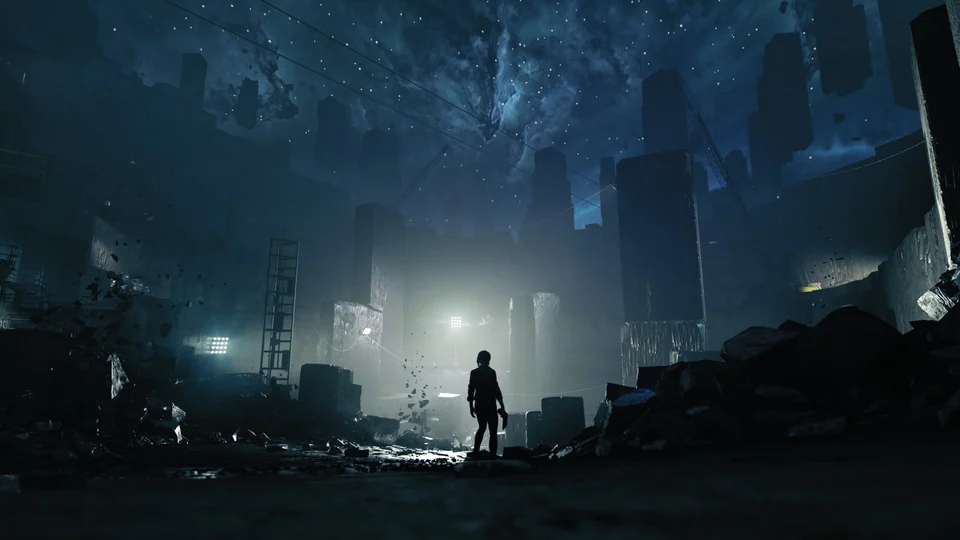
Physical architecture is fundamentally constrained by terrestrial physics: structural tensile strength, compressive loads, wind shear, foundation soil stability, and the relentless downward pull of planetary gravity. For thousands of years, human building traditions—from ancient Egyptian stone pillars to modern steel skyscrapers—have been defined by engineering solutions to avoid collapse.
In digital video game space, however, gravity is merely a mathematical constant defined in the engine's physics config file. It can be inverted, multiplied, localized to polygon surfaces, or eliminated entirely. Furthermore, digital geometry is not bound by physical Euclidean space. Portals can connect rooms whose external dimensions are smaller than their interiors, staircases can wrap around themselves indefinitely in recursive loops, and monolithic concrete structures can hang suspended over bottomless voids without a single support pillar.
When visionary game designers treat virtual architecture as an unconstrained artistic canvas, they create impossible geometries that disorient player perception, challenge intuitive cognitive maps, and expand the spatial vocabulary of the interactive medium.
Control and The Oldest House: Brutalism as a Living Organism
Remedy Entertainment's Control (2019) is one of the most stunning architectural achievements in contemporary gaming. The entire narrative takes place inside The Oldest House, a monolithic government skyscraper situated in downtown Manhattan that serves as the headquarters of the Federal Bureau of Control.
Architectural highlights of The Oldest House:
- Authentic Monumental Brutalism: Environmental art director Stuart Macdonald drew direct inspiration from mid-20th-century brutalist masterpieces, including Marcel Breuer's Boston City Hall, the AT&T Long Lines Building in New York, and Kevin Roche's Oakland Museum. Towering poured-concrete walls, geometric coffered ceilings, and sharp angular shadows communicate bureaucratic authority and timeless indifference.
- Shifting Non-Euclidean Topography: The Oldest House is an architectural shifting organism. During paranatural incursions, concrete walls slide like tectonic plates, corridors fold into impossible angles, and office cubicles reconfigure into bottomless stone chasms.
- The Ashtray Maze: The game's spatial masterpiece is an infinitely shifting labyrinth of hotel hallways and wood-paneled lounges that continuously reorients itself around the player, folding space into a synchronized rhythmic assault.
- Contrast of Corporate Order and Cosmic Chaos: Filing cabinets, executive desks, and vacuum mail tubes stand frozen in time while surreal obsidian monoliths pierce through office drywall, merging corporate mundane reality with cosmic horror.
Portal 2: Quantum Momentum and Seamless Spatial Manifolds
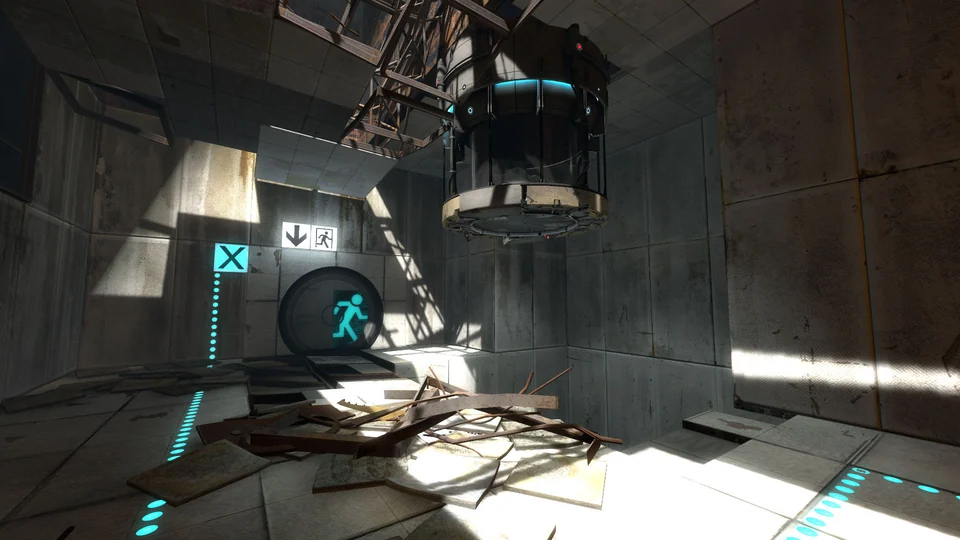
Valve Corporation's Portal and Portal 2 revolutionized interactive topology through the implementation of seamless render-to-texture and physics-translation portals.
The engineering brilliance of Aperture Science testing tracks:
- Continuous Velocity Conservation: The famous law of momentum—speedy thing goes in, speedy thing comes out—required Source engine programmers to map physical kinetic vectors through non-Euclidean spatial planes in real time without dropping collision frames.
- Monumental Subterranean Architecture: Portal 2 took players into the decaying salt mine shafts of 1960s and 1970s Aperture Science, where colossal geodesic test spheres hang suspended by steel cables in subterranean voids thousands of meters deep.
- Spatial Disorientation as Humor and Narrative: GLaDOS and Wheatley guide the player through test chambers that constantly rearrange modular wall panels, presenting an architecture that views human beings as disposable biological inputs.
Antichamber: The Triumph of Pure Non-Euclidean Geometry
Created by independent developer Alexander Bruce and released in 2013, Antichamber is a psychological first-person puzzle game that deliberately deconstructs the foundational rules of Euclidean geometry and player navigational expectations.
Non-Euclidean techniques in Antichamber:
- Direction-Dependent Corridors: Walking down a hallway while looking straight ahead leads to room A; turning around and walking down the exact same hallway leads to room B. The spatial outcome is determined by player gaze and traversal vector rather than static Euclidean coordinates.
- Recursive Spatial Portals: Players can look through windows that display entirely different rooms occupying the exact same volumetric space. Stepping through the window instantaneously teleports the player's coordinate frame without visual seams.
- Impossible Staircases: Ascending a four-sided square staircase brings the player back to where they started, creating physical loops inspired by M.C. Escher's celebrated lithograph Ascending and Descending.
- Color As Cognitive Gating: Bruce used stark white architectural walls accented with vibrant primary color blocks that represent puzzle gun tiers, forcing players to abandon spatial memory and adopt conceptual deduction.
Manifold Garden: Infinite Architectural Fractals
William Chyr's Manifold Garden (2019) takes gravitational architecture to its ultimate mathematical conclusion: infinite repetition in non-Euclidean space.
Key geometric systems in Manifold Garden:
- Six-Axis Gravity Switching: Players can change their gravitational orientation to any of the six planar faces of a cube by simply walking into a wall. The wall immediately rotates to become the floor, changing the perspective and function of every staircase, pillar, and archway.
- Infinite World Wrapping: The game's architectural spaces wrap around themselves infinitely. Jumping off a balcony into the void does not lead to death; instead, the player falls continuously through the repeating architecture, landing safely back on the exact same structure from above.
- Cellular Automata and Fractal Colonization: Bridges and towers replicate into distant horizons using fractal algorithms, creating dizzying vistas inspired by the architectural sketches of Piranesi and the geometric proofs of Frank Lloyd Wright.
Superliminal and Monument Valley: Forced Perspective Illusions
Other creators explore the malleability of space through optical perspective rather than physical geometry:
Based on the principles of forced perspective and trompe-l'œil, an object's physical size is determined entirely by where it appears relative to the player's field of view. Picking up a miniature chess piece and holding it up to the ceiling before letting go causes it to scale up into a colossal multi-ton monolith that smashes through doorways. Space expands and contracts based purely on visual framing.
- Superliminal (Pillow Castle Games):
Utilizing isometric axonometric projection, Monument Valley eliminates camera perspective foreshortening. What appears aligned on a two-dimensional screen becomes physically connected in three-dimensional game logic, allowing the silent princess Ida to walk across impossible geometric bridges that could not exist in real physical space.
- Monument Valley (Ustwo Games):
Limasse Five's NaissanceE constructs an incomprehensibly vast underground megastructure made of interlocking concrete cubes, endless ventilation shafts, and pulsing light fields, turning pure spatial scale into an existential meditation.
- NaissanceE: Monolithic Light and Subterranean Brutalism:
Echo: Palace of Infinite Symmetrical Duplication
Developed by Ultra Ultra (a studio founded by former IO Interactive veterans) and released in 2017, Echo is set inside a colossal, infinitely repeating extraterrestrial Palace buried within the core of a distant planet.
Architectural identity of the Palace:
- Opulent Neoclassical Symmetries: The Palace is rendered in immaculate marble, gilded molding, crystal chandeliers, and polished parquet flooring that stretches infinitely in all directions. The sheer perfection and endless repetition create an unsettling, dream-like uncanniness.
- The Blackout Cycle: The Palace operates on a systemic metabolic heartbeat. When the lights are on, the Palace's artificial intelligence monitors every action the player takes: sprinting, vaulting over balustrades, shooting firearms, or sneaking through water. During recurring blackouts, the Palace reboots and updates thousands of identical clones (Echoes) with the player's recorded behaviors.
- Monumental Interior Vistas: Halls featuring two-hundred-meter-high barrel vaulted ceilings dwarf the human characters, evoking the melancholic majesty of ancient royal mausoleums abandoned at the dawn of time.
Viewfinder and Portal: Spatial Recontextualization and Kinetic Discontinuity
Sad Owl Studios' Viewfinder (2023) and Valve's foundational Portal (2007) demonstrate how interactive mechanics can rewrite three-dimensional topology during real-time gameplay.
Key spatial transformation techniques:
- Instant Camera Placement in Viewfinder: Players hold photographs, vintage paintings, or architectural sketches up to their ocular field of view. When the snapshot is placed, the two-dimensional image instantly materializes into fully textured, physically navigable three-dimensional geometry, carving away whatever physical world previously existed behind it. An image of a Roman aqueduct becomes a traversable bridge across an empty sky canyon, proving that perspective dictates reality.
- Kinetic Momentum and Seamless Portals: Valve's Portal introduced seamless non-Euclidean spatial links: looking through a blue portal reveals the exact live view out of the orange portal with zero loading transition or visual latency. By maintaining kinetic velocity across gravitational axis reorientations—falling terminal velocity down into a floor portal to shoot horizontally out of a high wall—players experience exhilarating spatial liberation that defies terrestrial physics.
The Architecture of the Impossible
Virtual architecture in games like Control, Antichamber, Manifold Garden, and Echo transcends simple stage design to become a profound medium for philosophical inquiry. By shattering conventional geometry, these environments challenge players to rethink how space shapes human perception, emotion, and understanding.
In a digital sanctuary where the laws of nature are written in code, architecture is finally liberated from the tyranny of structural gravity. Designers can build monuments out of paradoxes, dreams, and infinite recursion, creating spatial experiences that physical stone can never hope to house.